Live Data Workout Music: How Your Watch Sets the Beat
Jordan MillsOctober 21, 2026 · 12 min read

Live Data Workout Music: How Your Watch Sets the Beat
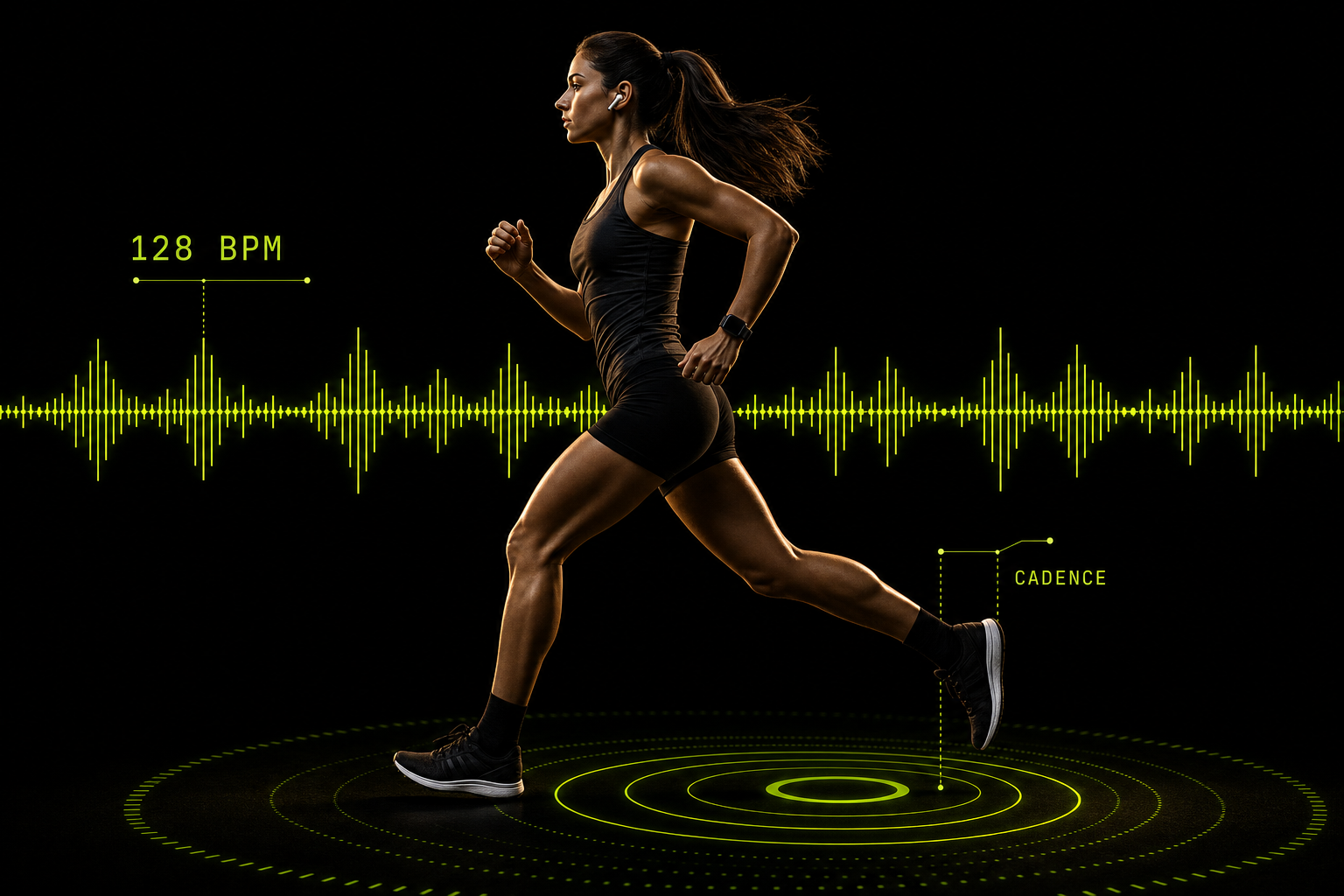
Live data workout music is music that changes while you exercise, because the tempo follows numbers your body is producing: heart rate, cadence and session intensity. A static playlist can’t do that. It plays the same 128 BPM track whether you are warming up or sprinting. With a watch or chest strap feeding an app in real time, the soundtrack can speed up when you need to push and slow down when you need to recover.
This guide explains how the data gets to the music, what the research says about tempo and effort, how to set it up for running, cycling and meditation, and what to look for in an app.
TL;DR
- Live data workout music adjusts tempo from signals such as heart rate and cadence, which come from a wearable like an Apple Watch or Fitbit, instead of from a fixed playlist.
- A 2025 research summary reports moderate gains in physical activity and a large gain in affective valence with adaptive music, and tempo is a key moderator.
- Runners and cyclists usually get the most from music that leads them toward a target. Meditation and recovery work better when the music mirrors you and helps you settle.
- Repbeats updates its music’s BPM every bar using live wearable data. We built it for people who train, not for casual listening.
Table of Contents
- What “live data” actually means for workout music
- Why tempo is the lever that matters
- Leading versus mirroring: two ways to map data to music
- Setting it up by activity
- What a good live-data music app needs
- A note on audio that isn’t music
- Our perspective
- Try it with Repbeats
- Getting started this week
- FAQ
- Sources
What “live data” actually means for workout music
Three signals matter most.

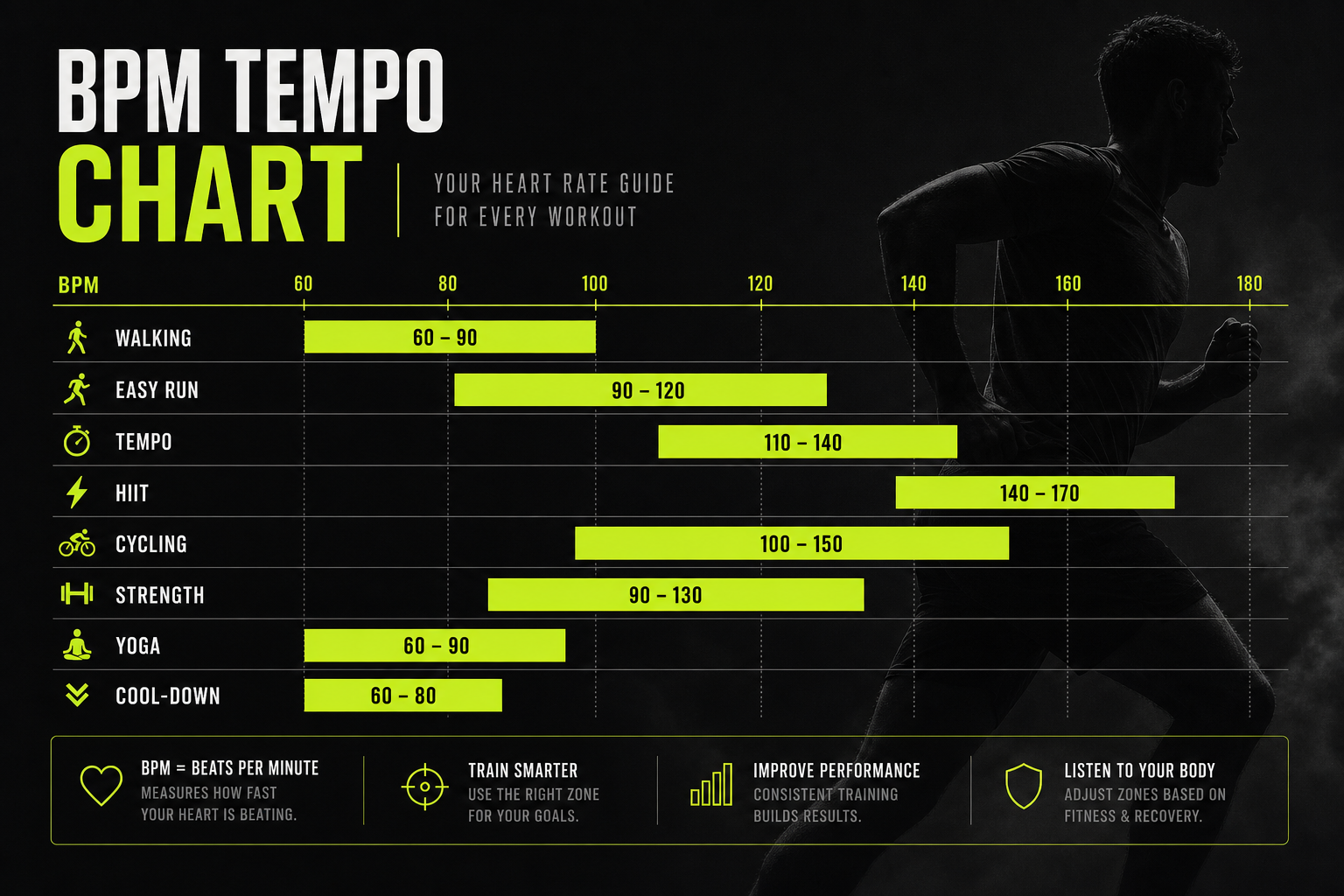
Heart rate. This tells the app how hard your body is working right now. It is the best guide to intensity for steady cardio, intervals and recovery, and it is why heart rate zones are so popular.
Cadence. Steps per minute for runners, pedal revolutions per minute for cyclists. Cadence is a rhythm, so it maps naturally onto beats per minute.
Session intensity. The plan for the workout: warm-up, work interval, recovery, cooldown. Even without a sensor, the app knows where you are in the plan and can set the tempo accordingly.
A live-data app reads these signals continuously and chooses or adjusts music to match. The question people type, “watch controlled workout music,” is really asking how much of this your wrist can do. Your watch collects the data and can drive playback. The app does the matching.
Static playlists, tagged playlists and adaptive music
There are three generations of workout music, and they behave very differently mid-run.
| Approach | How tempo is chosen | What happens when your effort changes |
|---|---|---|
| Static playlist | You pick songs in advance | Nothing. You skip tracks or live with the mismatch |
| BPM-tagged playlist | Songs are sorted by tempo range | You must change playlists by hand |
| Live data, adaptive music | The app reads sensors and sets tempo continuously | The music moves with you |
Wellness-tech commentators describe the same shift: early fitness music apps played static playlists, while the current standard is data-informed curation that adapts music to specific activity phases.
Why tempo is the lever that matters
Of all the things music can do (mood, lyrics, genre, familiarity), tempo has the strongest tie to how you move. A 2022 paper from researchers at National Yang Ming Chiao Tung University on interactive music tempo with heart rate feedback notes that rhythm, pitch and timbre mediate the effect of music in sport, and that tempo is considered the most important determinant of exercise response. People have a natural tendency to align their movement frequency with external rhythm.
That is the reason a 170 BPM track makes a 170 steps-per-minute cadence feel easier to hold, and why a slow ballad can make a hard interval drag. If you want the full mechanism, our explainer on why music tempo affects exercise goes deeper, and how music tempo affects your workout covers the body-level effects.
What the studies found
Research on adaptive and interactive music is young, but the direction is consistent.
- A 2025 analysis covered by Neuroscience News reports that adaptive music technology improved physical activity levels (g = 0.49) and affective valence (g = 1.65) during workouts, with tempo acting as a key moderator. In plain terms: people moved more and felt better doing it.
- The same coverage says synchronized interactive music let athletes raise their heart rate while their rating of perceived exertion fell, compared with asynchronous music or none. The work felt easier at the same or higher output.
- The 2022 basketball study above looked specifically at tempo that responded to heart rate feedback, which is the closest academic cousin of what a live-data app does.
- A Michigan Technological University paper, Tempo-Fit, explores heart rate sonification as feedback on exercise performance, and frames it as a way to encourage physical activity.
Treat these as encouraging, not as guarantees. Effect sizes vary by person, sport and study design, and none of them promise you a faster 10K. They do support a simple idea: when music responds to you, effort tends to feel better.
Leading versus mirroring: two ways to map data to music
There is a design choice inside every live-data music system, and it changes how the workout feels.
Prescriptive mapping tells you what to do. Your cadence is 160, the target is 170, so the music sits at 170 and pulls you up. Practitioners of adaptive music systems report that this approach is often more intuitive for runners and cyclists, because it creates a motivational loop: the beat leads and your body follows.
Descriptive mapping mirrors what you are doing. Your heart rate drops, the music slows with it. The same source suggests this suits biofeedback, recovery and meditation, where the goal is to downshift rather than push.
A good rule of thumb:
- Want to hold a pace, hit a cadence or finish intervals? Let the music lead.
- Want to cool down, recover or relax? Let the music follow you down.
Setting it up by activity
The details differ by sport. Here is how we would approach each.
Running
Cadence is the main number. Many runners aim somewhere between 150 and 185 steps per minute depending on pace, height and the type of run. We cover those ranges in long run music that adapts to your cadence, and for indoor miles, treadmill cadence music with live BPM sync and tempo-matched treadmill running music show how to set targets.
A practical start:
- Find your current comfortable cadence on an easy run.
- Set the music a few BPM above it for a week and see whether your steps drift toward the beat.
- Raise the target in small steps, not jumps.
Interval training
Intervals are where static playlists fail hardest, because the effort changes every minute or two. With live data, the music climbs into each work interval and eases off for recovery. Our walkthrough on automating treadmill interval music around a 130 BPM baseline gives a template you can adapt to the track or the road.
Cycling
For cyclists the signal is pedal cadence, plus heart rate for zone work. Spinning at 90 RPM against a song whose beat falls neatly on every second pedal stroke feels very different from fighting a mismatched rhythm. The principle is the same as running: tempo gives you a rhythm to lock onto.
Meditation and cooldowns
Here you want the opposite of drive. Descriptive mapping lets music slow as your heart rate falls, which gives you something external to follow down. It is a gentler use of the same data, and one reason we built meditation programs alongside cardio.
What a good live-data music app needs
Whether you choose ours or another type of app, check these points.
- Real wearable data, not guesses. Look for support for the watch you already own. Apple Watch and Fitbit are the common ones.
- Fast, smooth tempo changes. Music that lurches between tempos is worse than a static playlist. Changes should land on musical boundaries such as a bar line.
- Control over targets. You should be able to set zones and cadence goals, not just accept a default.
- Manual override. Real-time controls like pause, skip and music library search matter when a track isn’t working for you.
- Scheduling. If the app helps you plan sessions, you are more likely to use it consistently.
- Privacy limits. Workout data is personal. Check what device access the app requests and why.
- Music you actually like. The best tempo match means little if you dislike the genre. Genre is moving too: Feed.fm’s 2025 report says fitness programming is blurring genres, with popular tracks often around a 110 BPM four-on-the-floor beat. Phonk is also climbing as a high-intensity choice in 2026, and Feed.fm notes some tracks passing 500 million streams.
A note on audio that isn’t music
Not everyone wants a beat every run. Some runners prefer spoken stories on easy days and tempo-matched music on hard days. If that’s you, this guide to audiobook formats for different jogging routes is worth a look. It is written in German, but the route-by-route thinking applies to any language. Keep the tempo-matched music for the sessions where pace and cadence are the goal.
Our perspective
We started Repbeats because we kept seeing the same problem. People who train carefully, with zones, cadence targets and structured intervals, still pressed play on a playlist that knew nothing about any of it. The music was the one part of the workout that wasn’t measured.
So we made the music respond. Repbeats reads live data from wearables like Apple Watch and Fitbit and updates the music’s BPM every bar, so the tempo stays tied to your heart rate, cadence and session intensity instead of drifting away from them. We think bar-level updates matter, because a change that lands on the beat feels like part of the song rather than an interruption.

We also think the field is right to separate leading from mirroring. When you are pushing, you want the music to pull. When you are winding down, you want it to follow. That distinction shapes how we think about cardio programs versus meditation ones.
And we keep the data footprint small. Our privacy policy limits device access to workout data only. If you want a deeper look at how we think about training with adaptive music, our piece on adaptive music workout best practices for athletes lays out the approach.
— Jordan Mills
Try it with Repbeats
Repbeats is a fitness app for runners, cyclists, meditators and anyone who trains with a wearable. It syncs music tempo to your heart rate, cadence and session intensity, offers cardio and meditation programs, and lets you control playback, search the music library and schedule programs. Waitlist members get a free year at launch. You can read more on the Repbeats app page or start from the Repbeats home page.
Getting started this week
You don’t need to overhaul your routine. Try this sequence:
- Day 1: Do an easy 20 to 30 minute session wearing your watch and note your average heart rate and cadence.
- Day 3: Repeat with music set to lead you slightly above that cadence.
- Day 5: Do a short interval session and let the tempo follow the work and recovery blocks.
- Day 7: Finish with a meditation or cooldown where the music follows your heart rate down.
Then compare how each session felt, not just the numbers. Perceived effort is a useful metric, and it is the one the research suggests music can shift. For a ready-made starting point, see our four BPM-matched workout music templates, and for the technology behind it, AI workout music for wearables that syncs to heart rate in real time and what adaptive workout music is.
If you have a heart condition, take medication that affects heart rate, or are returning to exercise after illness, talk to your doctor before setting new heart rate targets. Music can change how hard a session feels, so don’t let it push you past the limits your clinician gave you.
FAQ
Can my watch control my workout music?
Yes, to a point. A watch can start, pause and skip tracks, and it supplies live heart rate and motion data. An adaptive app uses that data to change the tempo of the music automatically, so you aren’t tapping your wrist to find a faster song.
Does music tempo really change how hard a workout feels?
Research points that way. A 2025 summary reports that synchronized interactive music let athletes raise heart rate while perceived exertion decreased compared with asynchronous or no music. Individual results vary.
What BPM should my workout music be?
It depends on the activity. For running, match your target cadence, often in the 150 to 185 steps-per-minute range. For intervals, move between a lower recovery tempo and a higher work tempo. For meditation, let the tempo fall with your heart rate.
Is live data workout music only for runners?
No. Cyclists can sync to pedal cadence, gym-goers to heart rate zones and meditators to a slowing heart rate. Running is the easiest place to feel the effect because cadence maps so directly to beats per minute.
Sources
- Adaptive Music Tech Makes Workouts More Fun, Helps People Stay Active, Neuroscience News
- Effects of Interactive Music Tempo with Heart Rate Feedback on Physio-Psychological Responses of Basketball Players, IJERPH 2022
- Tempo-Fit heart rate app: Using heart rate sonification as exercise performance feedback, Michigan Technological University
- 2025 Year in Music for Fitness & Wellness, Feed.fm
- Empowering women’s health with music, FemTech World